Bringing a new customer back: the first 90 days
Signing up is only the beginning. What happens in the next three months decides whether this customer becomes a regular, or just one more name on your list.
By the HoorayPass teamPublished September 29, 20267 min readJump to sources

On this page
The problem: signing up isn’t enough
A customer joins your card, leaves with their welcome stamps... and never comes back. It’s not rare. According to the 2026 report from Paytronix, a loyalty software vendor, 75% of new bar and grill members are inactive 90 days after signing up.
On the other hand, a returning customer is worth a lot. Square’s 2026 Local Economy Report finds that a regular, who comes at least 4 times a year, brings in 6 times more than a one-time customer. And according to Toast’s Regulars Report 2026, the return rate goes from about 7% to nearly 30% among loyalty program members.
Two honest caveats. These figures mostly come from US restaurants, published by companies that sell loyalty tools. And they show a link, not proof: your best customers sign up on their own, and a card mostly benefits people who already liked your business. The real work of the first 90 days is turning a passing customer into one who comes back.
The second visit matters most
A first visit is a discovery. The second is the start of a habit. Everything you do in the first weeks should aim at one thing: getting the new member through the door a second time.
Two levers already help, before any message:
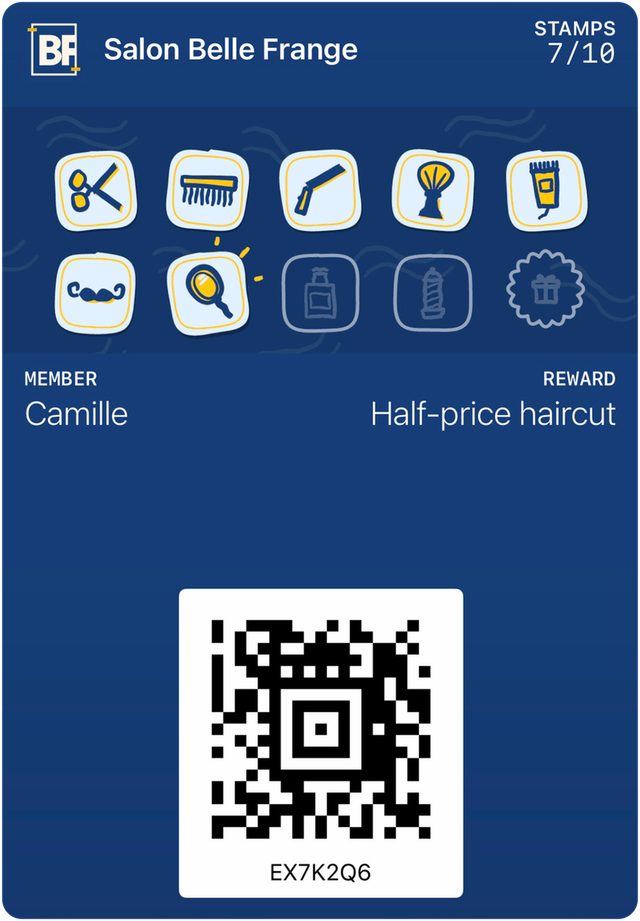
- Welcome stamps. A customer who leaves with 2 out of 10 stamps feels they’ve started. They want to finish.
- A reachable reward. If the card fills in 8 weeks or less, the reward stays on the customer’s mind.
The five messages that bring people back
Here’s the sequence we recommend, with the timings we use by default. Adjust them to your business’s rhythm.
1. The welcome note, right away.
It confirms the sign-up and mentions the free stamps. No promo, just a thank you.
Example Sample message “Welcome to Café des Habitués, Camille. Your card is ready. See you soon.”
2. The invitation to come back, if the second visit is slow to come.
By default, after 21 days without a second visit; between 14 and 30 days depending on your trade. This is the message that matters most.
Example Sample message “It’s been a while, Camille. Your next stamp is waiting at the counter.”
3. “Just one more stamp.”
When only one stamp is missing, a short reminder. Customers naturally speed up as the reward gets close: this message gives them the final nudge.
Example Sample message “Just one more stamp until your free coffee.”
4. The reward that’s waiting.
A reward earned but not used is a visit that hasn’t happened yet. Two reminders are enough: at 7 days, then at 21 days.
Example Sample message “Your free coffee is waiting. It’s yours on your next visit.”
5. Win-back for absent customers.
When a regular stops coming, the right moment depends on them. We trigger the win-back at about twice their usual interval: a weekly customer gets a note after two weeks away, not two months.
Example Sample message “We miss you, Camille. Drop by this week.”
A sixth message is often welcome: the birthday, a few days ahead, if the customer shared the date. Always ask for it as an option, never a requirement.
Recognition beats discounts
A discount attracts; recognition retains. According to Toast, for 48% of customers, what matters most is staff remembering their name or usual order. Only 30% always feel recognized.
At the counter, saying “Hi Camille, the usual?” costs nothing. A digital card can show the first name and number of visits at scan time: your team just has to smile.
Don’t be annoying
Customers are demanding: in Canada, according to the Bond Loyalty Report 2025, only 32% say they’re very satisfied with their loyalty programs, versus 48% in the United States. A program that sends too many messages quickly loses its place.
Three simple rules:
- Keep service separate from promos. “You have 2 stamps left” is information. “20% off muffins” is a promo, which requires the customer’s consent.
- Cap promos. Two a month per customer, all channels combined, is a good start.
- Make unsubscribing easy, and apply it right away.
Your team does half the work
The card doesn’t sign people up on its own. Give your team one line, always the same: “Would you like your loyalty card?” Track sign-ups by staff member; a friendly contest between colleagues often helps more than a poster.
Measure what matters
Merchants think about sales first, and that’s normal: among the questions restaurant owners ask Toast’s assistant, 47% are about sales and only 7% about loyalty. So measure the card in dollars and visits, not “engagement”:
- Sign-up rate: out of 100 transactions, how many new members?
- Return at 30, 60 and 90 days: what share of your new members came back?
- The bottom line in dollars: what members spent, minus the real cost of rewards, minus what the card costs you.
If the 30-day return is low, look first at the second-visit message and the line at the counter.
The checklist
- I have chosen whether to offer welcome stamps, and how many.
- A welcome note goes out right away, with no promo.
- An invitation goes out if the second visit is slow to come (14 to 30 days).
- “Just one more stamp” and “your reward is waiting” go out on their own.
- Absent customers get a note based on their usual rhythm.
- My promos are capped and easy to stop.
- My team says the same line to every customer.
- I check return at 30, 60 and 90 days, and the bottom line in dollars.
Sources
- Paytronix, 2026 Loyalty Report (figure published by a loyalty software vendor)(opens in a new tab)
- Square, 2026 Local Economy Report (vendor figure)(opens in a new tab)
- Toast, Regulars Report 2026 (vendor figure)(opens in a new tab)
- Bond Loyalty Report 2025(opens in a new tab)
- Food On Demand, use of Toast’s assistant, June 2026(opens in a new tab)
- Nunes and Drèze, 2006, the endowed progress effect (summary)(opens in a new tab)