Retail loyalty glossary
The words of loyalty cards, explained for business owners: a one-sentence definition, an example from a real kind of shop, and where to go next.
Updated September 30, 2026
Where to start
New to the topic? Start with the digital loyalty card, then the stamp card: every other term builds on them. The welcome stamp comes next, because it is the setting that costs least and changes most.
Comparing providers? Apple Wallet, Google Wallet and the wallet pass explain where the card lives on your customers' phones and why no app is needed. The loyalty QR code shows what happens at the counter.
Already running a card? The customer return rate tells you whether it brings people back. Before sending a promotion, read express consent: most anti-spam laws require it.

The card and its rewards
How a program rewards visits, spending or referrals, and how to set it up.
Digital loyalty card
A digital loyalty card replaces the paper card with a card on the customer’s phone: it counts their visits or points and shows their reward, with nothing to print.
Stamp card
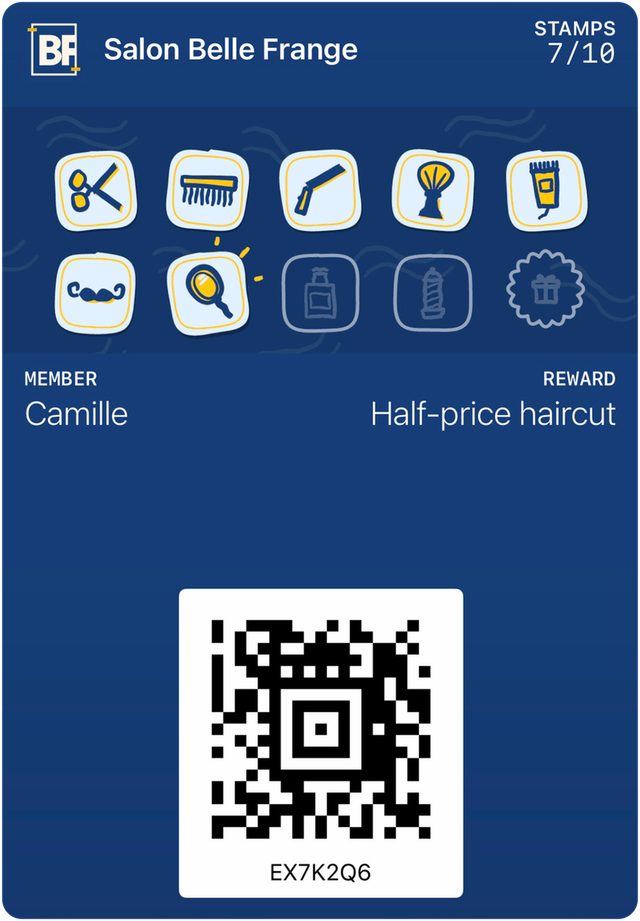
A stamp card rewards repeat visits: the customer gets one stamp per purchase and earns a reward when the last box is filled.
Welcome stamp
A welcome stamp is a stamp given at sign-up, so that a new member’s card starts already under way.
Points-based loyalty program
In a points-based loyalty program, every dollar spent earns points that the customer later exchanges for a reward.
Loyalty credit
Loyalty credit gives the customer back part of each purchase, as money to spend on their next visit.
Tiered loyalty program
A tiered program sorts your customers into levels, for example Regular then VIP. The more a customer visits or spends, the higher they go, and the more benefits they get.
Referral program
A referral program rewards a customer who brings you a new customer. Often, the newcomer gets a gift too.
Your customer’s phone
Where the card lives, how it gets scanned at the counter, and how it lets your customers know.
Apple Wallet
Apple Wallet is the wallet app built into the iPhone: it holds bank cards, tickets, boarding passes and loyalty cards.
Google Wallet
Google Wallet is the digital wallet on Android phones: it brings together payment cards, tickets, boarding passes and loyalty cards.
Wallet pass
A wallet pass is a card, ticket or coupon that lives in the phone’s wallet and updates remotely, with no app.
Loyalty QR code
A loyalty QR code is the square to scan that, depending on where it is shown, either signs a customer up or identifies a member’s card at the counter.
Wallet notification
A wallet notification is a short message that appears on the customer’s phone when their loyalty card changes in Apple Wallet or Google Wallet.
Measuring what the card brings in
Knowing whether the card brings people back, how often, and what a loyal customer is worth.
Customer return rate
The return rate is the share of customers who come back at least once within a set period after a first visit, for example 30, 60 or 90 days.
Visit frequency
Visit frequency measures how often a customer comes back, for example twice a week or once a month.
Enrollment rate
The enrollment rate tells you how many new members you gain for every 100 checkout transactions, over the same period.
Customer lifetime value
Customer lifetime value estimates what a customer brings you in total, from first to last purchase.
Control group
A control group is a few customers, drawn at random, who don’t receive a promotion. By comparing them with the others, you see what the promotion really added.
Messaging your customers by the rules
Consent, unsubscribing and personal information, explained for a business.
Express consent
Express consent is a person’s clear, voluntary agreement to receive promotional messages, given through an active step such as ticking a box.
Unsubscribe
Unsubscribing is when a person asks to stop receiving your promotional messages. You must then stop sending them.
Anti-spam law
An anti-spam law sets the rules for sending promotions by email or text. It protects people from messages they didn’t ask for.
Personal information protection
Personal information protection means the rules on what a business can collect, use and keep about a person who can be identified. For example their name, phone number or visit history.
With neighboring businesses
What businesses on the same street can do together.
Business association
A business association brings together the businesses on one street or in one neighborhood. Together, they liven up the area, promote it and defend their interests.
Neighborhood gift card
A neighborhood gift card can be spent at every member business on the same street or in the same business association, rather than at just one business.
See your business’s card
Send us your logo: we prepare a preview of your card and show it to you on video.