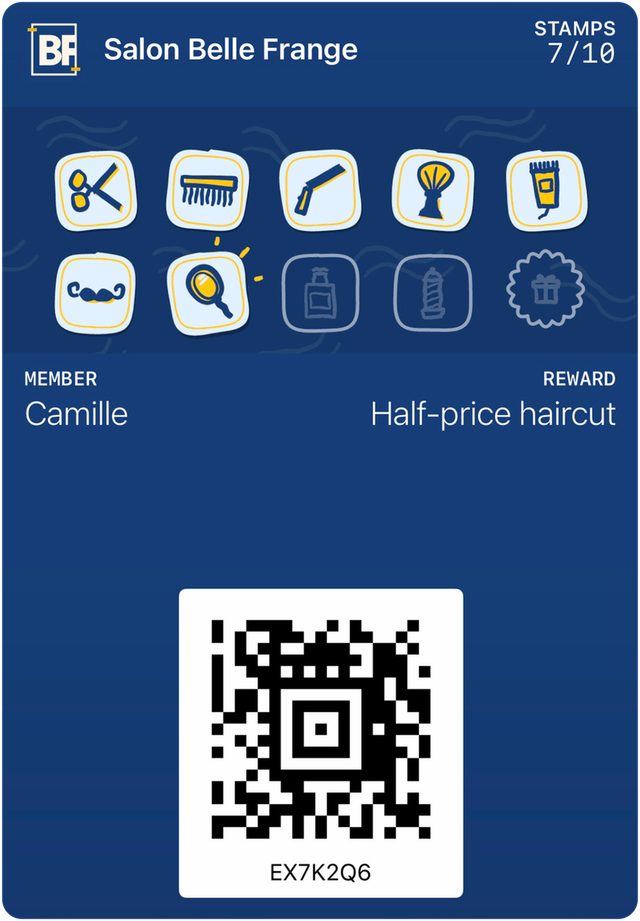
How many stamps should your loyalty card have?
Short answer: few enough that a regular fills their card in 8 weeks or less. Here’s why, and how to work it out for your business.
By the HoorayPass teamPublished September 29, 20267 min readJump to sources

On this page
The 8-week rule
A loyalty card works when the reward feels within reach. A 2026 study by FaveCard, a loyalty card vendor, tracked 23,296 stamps across 1,013 small businesses. Its findings are clear: a card that fills in 2 to 4 weeks gets completed 11.4% of the time. Past 16 weeks, fewer than 1% of cards make it to the end. And 56% of small-business cards take more than 8 weeks to fill.
Customers say so too: in Antavo’s 2026 report, 49.1% of loyalty program members complain that rewards take too long to earn.
So keep one simple benchmark in mind: a regular should be able to fill their card in 8 weeks or less. Between 8 and 16 weeks, the card runs out of steam. Past 16, it barely does anything.
The formula
You need two numbers: the average time between two visits from a good customer, and how many stamps they still need to earn.
Weeks to fill the card = (days between visits × stamps to earn) ÷ 7
“Stamps to earn” means the stamps on the card minus the ones you give away at sign-up. More on that below: it’s the most profitable trick on the whole card.
Examples by trade
The visit frequencies below are assumptions for the example. Replace them with what you see at your counter.
| Business | Good customer visits (assumption) | Stamps on the card | Free at sign-up | Weeks to fill |
|---|---|---|---|---|
| Café | every 2 days | 10 | 2 | about 2 |
| Bakery | every week | 8 | 2 | 6 |
| Restaurant | every week | 8 | 1 | 7 |
| Car wash | every 2 weeks | 5 | 1 | 8 |
| Barber | every 5 weeks | 5 | 1 | 20 |
For comparison, here are FaveCard’s recommended ranges by trade: café, 8 to 10 stamps; quick-service restaurant, 5 to 6; hair salon, 3 to 5; nails, 5 to 6.
When visits are far apart
Look at the last row. A customer who comes every 5 weeks takes 20 weeks to fill a 5-stamp card, even with one free stamp. That’s over the 16-week line. Cutting more stamps eventually makes the reward too easy.
For a barber, hair salon or beauty business, three approaches work better than trimming the card:
- A small reward halfway. A product or a short treatment on the third visit, the big reward at the end. There’s always something close to aim for.
- A reminder at the right time. “It’s been 5 weeks since your haircut.” The reminder doesn’t shorten the card, but it keeps the visit from slipping to 7 or 8 weeks.
- Recognition rather than discounts. A “Regular” status shown on the card costs nothing and speaks to customers who’ve been loyal for years.
The free-stamp trick
This is the best-known experiment on the subject. Two researchers, Joseph Nunes and Xavier Drèze, gave car wash customers one of two cards. The first: 8 empty slots. The second: 10 slots, 2 already stamped. Either way, it took 8 washes. Yet 34% of the “2 free stamps” cards were completed, versus 19% of the empty cards.
Same effort, nearly twice as many completed cards. A customer who starts at 2 out of 10 feels they’ve already begun, and wants to finish.
Another study, in a café with a 10-stamp card, shows a second effect: the closer the reward, the faster customers come back. The time between purchases shrank by about 20% as the free coffee got close.
The practical takeaway: give 1 or 2 stamps at sign-up, and add the same number of slots to the card. Your cost doesn’t change; your completion rate does.
An 8-slot card, all empty at the start.
19 %
of cards were completed
A 10-slot card, 2 already stamped.
34 %
of cards were completed
Source: Nunes and Drèze, 2006, academic study with car wash customers. The cards drawn here are an illustration.
Choosing the reward
The reward should be desirable and clear. “A free coffee” beats “10% off your next purchase”. A few pointers:
- Price its real cost. A free coffee doesn’t cost you its menu price, only the ingredients: roughly $0.50 to $1. That’s the cost that counts in your math.
- Keep it simple. One reward per card, written in one sentence. Choice rewards or points can come later, if customers ask for more.
- Mind the law. Depending on the country or region, loyalty programs can fall under consumer protection laws, especially when a reward has a high value or an expiry date. Check the rules that apply where you are before launching the card.
Five common mistakes
- A card that’s too long. 15 stamps for a customer who comes once a week is almost 4 months. They give up first.
- No free stamps. Starting from zero is discouraging, when one or two free stamps cost so little.
- A vague reward. “A surprise” or “a discount” doesn’t excite anyone. Name the reward.
- Rules that change midway. If you must change them, tell your customers and honour stamps already earned.
- Forgetting to offer the card. The best card in the world is useless if nobody mentions it at the counter. One line does it: “Would you like your loyalty card?”
In short
- Aim for a card a good customer fills in 8 weeks or less.
- Work it out: (days between visits × stamps to earn) ÷ 7.
- Give 1 or 2 stamps at sign-up, and add as many slots.
- For visits far apart, add a small halfway reward and a well-timed reminder.
- Name a simple reward, and price its real cost.
Sources
- FaveCard, study of 1,013 small businesses, 2026 (figure published by a loyalty software vendor)(opens in a new tab)
- Antavo, Global Customer Loyalty Report 2026 (vendor figure)(opens in a new tab)
- Nunes and Drèze, 2006, the endowed progress effect (summary)(opens in a new tab)
- Kivetz, Urminsky and Zheng, 2006, goal-gradient acceleration(opens in a new tab)
- Legislative Assembly of Ontario (Canada), Bill 47 on rewards points, 2016(opens in a new tab)
- ACCC (Australia), customer loyalty schemes, final report, December 2019(opens in a new tab)