Which reward can you offer without losing money?
A good reward makes people want to come back and costs little. The secret fits in one line: you count it at its cost of goods, not its menu price. Here is how to do the math and pick the one that suits your business.
By the HoorayPass teamPublished September 30, 20266 min readJump to sources

On this page
The menu price is not the cost
When an owner hesitates to give away a coffee or a slice of cake, they often think of the price on the board. That is not what the reward costs them. What it costs is its cost of goods: ingredients, packaging and, for a service, the staff member’s time.
A concrete example: according to a coffee equipment supplier, the ingredients for a 12-ounce latte cost about US$1.00 to US$1.55 in 2026 (coffee, milk, cup and lid). Sold at US$4.50, that latte leaves a gross margin of about 72%. Giving it away doesn’t cost you US$4.50, but a little over a dollar.
Your numbers will differ: they depend on your suppliers, your portions and your country. The principle doesn’t change.
The number that matters: cost per visit
A reward is only given after several paid visits. To know what it really costs you, divide its cost of goods by the number of paid visits it requires.
Cost per visit = cost of goods of the reward ÷ paid visits to earn it
- Cost of goods of the latte (middle of the quoted range)
- US$1.25
- Paid visits to earn it
- 8
- Cost per visit
- about US$0.16
Compare that with a 10% discount on every US$4.50 coffee: US$0.45 per visit, on every visit, whether the customer is loyal or not. The product reward costs almost three times less per visit, and only customers who come back get it.
Treat or discount?
Both work, but not in the same businesses. Data published by Toast, a point-of-sale vendor for restaurants, over 90 days in the first quarter of 2026, shows it clearly:
- In casual restaurants, like pizzerias and cafés, cash back gives the best 90-day retention: 24 to 26%.
- In fine dining, a free appetizer or dessert does better: 20% retention, versus 13% for cash back.
An older study by Ran Kivetz and Itamar Simonson (2002) sheds light on this: the greater the effort required, the more customers prefer a “treat” over a practical discount. After ten visits, people feel they have earned something indulgent, not a rebate.
Let the customer choose
According to Antavo, 81% of program members prefer brands that let them choose their reward. A small business doesn’t need a catalogue: two or three choices of similar value are enough. For example, a coffee, a pastry or an iced tea.
Just make sure the choices have a similar cost of goods. Otherwise, everyone will take the most expensive one, and your math won’t hold.
Services: the real cost is time
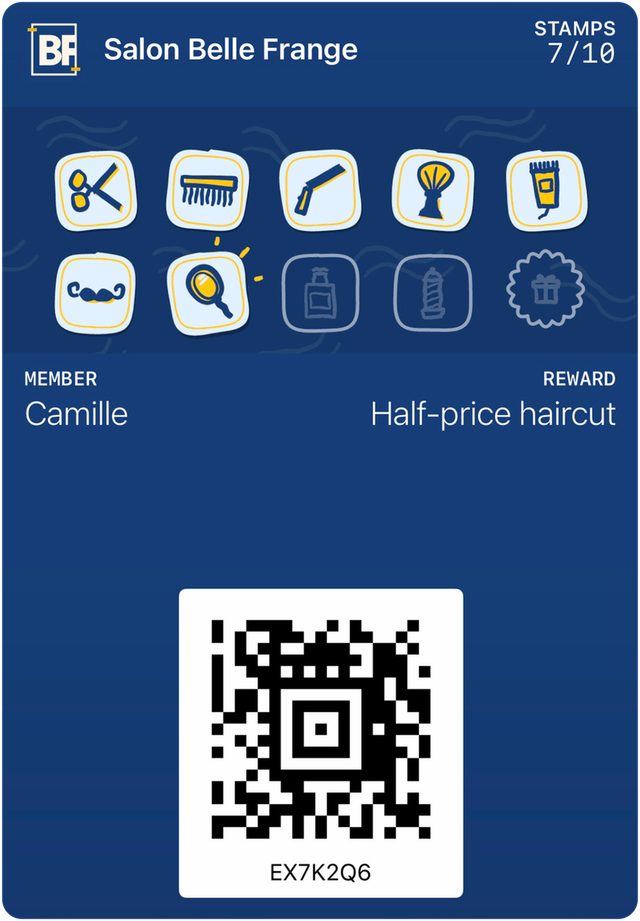
In a salon, a barbershop or a spa, giving away a full haircut means giving away an hour of work, sometimes at a time when you could have served a paying customer. The cost of goods of a service is first of all that time.
A few rewards that take little time and still please:
- A short treatment added to the appointment, like a scalp massage or a polish.
- A travel-size product, which you buy in bulk.
- A halfway reward, smaller, then a nicer one at the end of the card.
- A reserved time slot for regulars, which costs you nothing and feels special.
Pitfalls to avoid
- A vague reward. “A surprise” or “a discount” excites no one. Name it in one sentence.
- A reward that costs you a sale. Giving away your most popular item at Saturday lunch can cost you a paying customer. Specify days or sizes if needed.
- A reward too expensive for its card. If the cost per visit is higher than the margin a customer brings you per visit, the card loses you money. Redo the math.
- A forgotten expiry date. Depending on the country, consumer protection rules govern the expiry of points and rewards. Check before setting a date.
The most common rules on point and reward expiry are summed up in our consumer protection guide.
Before you choose, check
What HoorayPass does
During setup, HoorayPass suggests a reward that doesn’t cost you too much and the number of stamps that goes with it, set for your trade. After that, the dollar report does the math for you: your members’ sales, minus the real cost of rewards, minus the subscription.
Sources
- Coffee Machine Depot, “Cafe Pricing and Margins 2026”, June 2026 (equipment supplier, costs in US dollars)(opens in a new tab)
- Toast, Regulars Report 2026, reported by Fast Casual (vendor data, US restaurants)(opens in a new tab)
- Kivetz and Simonson, 2002, “Earning the Right to Indulge”, Journal of Marketing Research (academic study)(opens in a new tab)
- Antavo, 2026 loyalty statistics (vendor data)(opens in a new tab)