Welcome stamps at sign-up: what the effect really changes
Two free stamps on a slightly longer card: same effort for the customer, almost twice as many completed cards in the reference study. Here is what it really measured, its limits, and how to set up your card.
By the HoorayPass teamPublished September 30, 20266 min readJump to sources

On this page
The car wash study
In 2006, two marketing researchers, Joseph Nunes and Xavier Drèze, ran a simple experiment at a car wash. Three hundred customers received a loyalty card for a free wash. Half got an 8-space card, all empty. The other half got a 10-space card with 2 spaces already stamped.
Either way, it took 8 paid washes to earn the reward. Same effort, same gift. Only the presentation changed.
Nine months later, 19% of the empty cards had been completed. For the cards that started with 2 stamps, it was 34%. Almost twice as many, for exactly the same number of visits.
The same effect, measured in a café
Another team, Ran Kivetz, Oleg Urminsky and Yuhuang Zheng, published a study the same year from a university café. Some customers got an ordinary 10-space card. Others got a 12-space card with 2 “bonus” stamps already on it. Once again, it took 10 purchases either way.
Customers with the 12-space card made their 10 purchases in 12.7 days on average, versus 15.6 days for the ordinary card. Nearly three days sooner, or about 20% faster.
The same study shows a second effect: the closer the reward, the faster customers come back. In that café, the time between purchases shrank by about 20% as the free coffee got close. Two free stamps bring the goal closer from day one, so the speed-up starts earlier.
Why it works
Researchers call it the endowed progress effect. A task that already seems underway motivates more than a task starting from zero. A customer who sees 2 of 10 spaces filled feels they have “already started”, and they want to finish what they started.
The flip side shows up in surveys. In the 2026 report from Antavo, a loyalty software vendor, 49.1% of program members complain that rewards take too long to earn. An empty card reinforces that feeling at first glance.
What it really costs
A free stamp costs nothing on the day you give it. It only costs something when the customer claims the reward, and only if they made the paid visits the card asks for.
If you add as many spaces as free stamps, each reward you give still matches the same number of paid visits as before. The only extra “cost” is that more customers reach the end of the card. That is exactly the point: each completed card stands for, in the car wash example, eight paid visits.
The real risk lies elsewhere: giving stamps without adding spaces. The card gets shorter, the reward comes sooner, and it costs you more per visit. That isn’t necessarily a mistake, if your card was too long, but it is a different decision, and one to work out.
To work out the real cost of a reward, start from its cost of goods, not its selling price. Read the article on choosing a reward
What the study doesn’t say
These results are solid, but they come with context. Before applying them, keep three limits in mind:
- These are two studies, in two businesses. A car wash and a café, with customers who came back often. A business where customers visit every two months won’t necessarily see the same gap.
- The effort stays the same. In both experiments, the “bonus” card required as many purchases as the empty one. Giving stamps without adding spaces shortens the card: a different setting, with a different cost.
- The percentages don’t carry over as they are. 34% of completed cards at a car wash in 2006 is not a promise for your business. What carries over is the direction of the effect.
How to apply it in your business
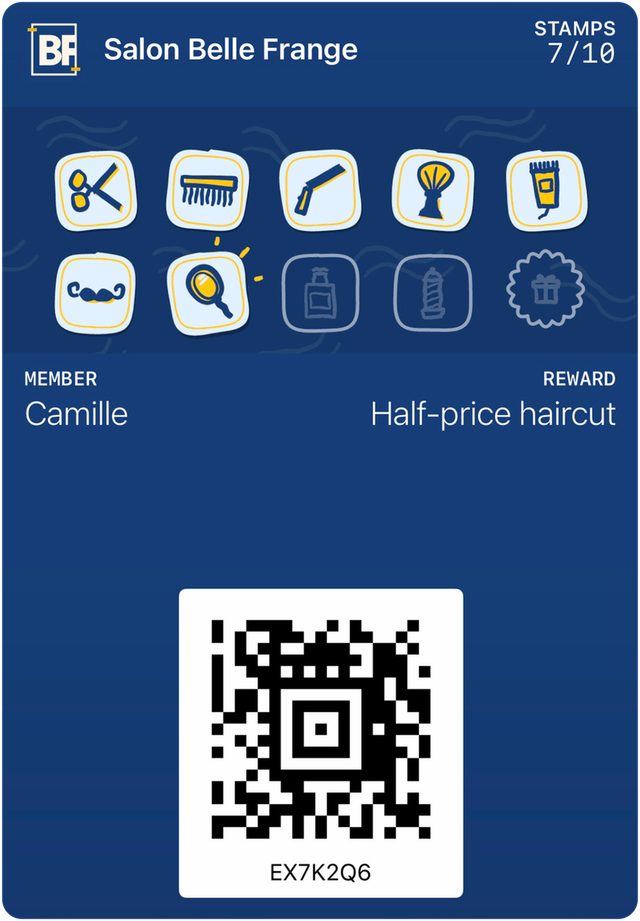
The simplest setting copies the experiment exactly: give 1 or 2 stamps at sign-up and add as many spaces to the card. Your reward costs no more, and it arrives after the same number of paid visits.
- Starting card
- 8 spaces, 0 free
- Adjusted card
- 10 spaces, 2 free at sign-up
- Paid visits to earn the reward
- 8 either way
- Cost of the reward
- unchanged
A few tips drawn from what the studies show:
- Keep it modest. One or two stamps are enough. If the card is almost full at sign-up, the reward feels too easy and loses its value.
- Say it at the counter. The effect comes from what the customer sees. “Would you like your loyalty card?” is a line that gets people to sign up and shows them the gift.
- Think about the next card. The café study also shows that purchases slow down right after a reward. A free stamp on the new card can help restart the rhythm.
- Carry over paper cards. Regulars who already have stamps on paper keep them, with a bonus only if you choose one: the same principle, applied to switching cards.
Carrying over paper cards, step by step, is covered in a separate article. Read the guide to moving from paper cards to digital
What about the number of spaces?
Free stamps don’t fix a card that is too long. If a good customer takes six months to fill their card, two extra stamps won’t be enough. Start by checking that your card fills in 8 weeks or less, then decide whether to offer welcome stamps.
The 8-week rule and the formula are in our article on the number of stamps. Read the article on the number of stamps
What HoorayPass does
You choose the stamps required, the reward and any welcome stamps, including none. We prepare the settings with you.
Sources
- Nunes and Drèze, 2006, “The Endowed Progress Effect”, Journal of Consumer Research (summary of the study)(opens in a new tab)
- Kivetz, Urminsky and Zheng, 2006, “The Goal-Gradient Hypothesis Resurrected”, Journal of Marketing Research (academic study, PDF)(opens in a new tab)
- Antavo, Global Customer Loyalty Report 2026 (vendor data)(opens in a new tab)