Moving from paper cards to digital without losing a single regular
Your regulars have stamps on paper, sometimes an almost full card. Going digital should earn them something, never cost them what they already have. Here is a simple timeline, the carry-over rule and what to say at the counter.
By the HoorayPass teamPublished September 30, 20266 min readJump to sources

On this page
The principle: no one loses anything
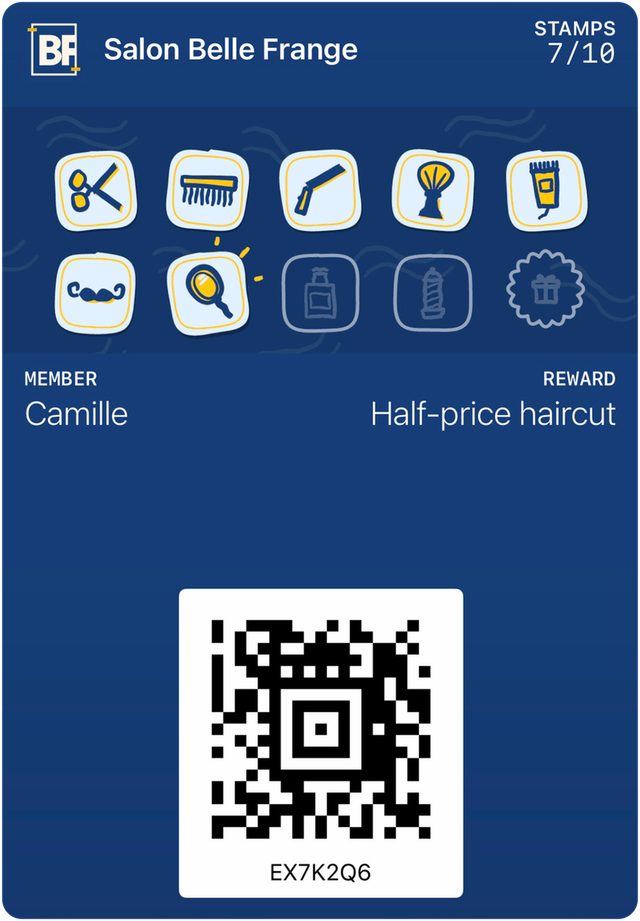
A paper card is a promise. A customer with seven stamps out of ten expects their free coffee, and rightly so. Going digital must never reset their count to zero.
The simplest rule is also the fairest: every paper stamp becomes a digital stamp, with no automatic extra. Any bonus and its size are your choice.
If you choose a bonus, here is the principle behind that option. Studies on loyalty cards show that a card that already looks started is completed more often: in Nunes and Drèze’s experiment at a car wash, 34% of cards that started with two free stamps were completed, versus 19% of empty cards, for the same effort.
The car wash experiment and its limits are explained in detail in our article on welcome stamps. Read the article on welcome stamps
Some customers like paper
Don’t assume everyone was waiting for this change. In Antavo’s 2026 report, from a loyalty software vendor, 41.0% of program members say they still use a plastic card, almost as many as those who use a digital card on their phone (42.4%).
That is why a transition period matters. For a few weeks, the paper card is still accepted, and every visit becomes a chance to offer the carry-over, without forcing it.
The four-step timeline
Here is the timeline we suggest. Adjust the durations to your customers’ rhythm: a café sees its regulars every week, a salon every five weeks.
Before launchSet the rules
Choose the start date and the end of the paper card. Every earned stamp is kept. Decide separately whether to offer a bonus, and how many stamps.
Day 1Post and announce
Put up the poster with the QR code at the counter. Every staff member offers the new card to every customer, with or without a paper card.
Weeks 1 to 8Carry over at the counter
The customer shows their paper card, staff carry over the earned stamps and apply only the bonus you selected. The paper card is kept or crossed out so it can’t be used twice.
After 8 weeksClose the paper card
Announce the end of the paper card. Latecomers keep their stamps: staff still carry them over. Any bonus remains your choice.
Special cases
A few situations come up often. It’s better to have the answer before a customer asks.
- The paper card is full. Hand over the reward already earned, then sign the customer up for the digital card. You decide whether to offer any welcome stamps.
- The customer has several half-full cards. Add up the stamps, up to one reward. Beyond that, give the reward and carry over the rest.
- The customer has no smartphone, or doesn’t want to use it. Keep a simple option for them, like continuing their paper card. If their phone has neither Apple Wallet nor Google Wallet, a web card, opened in the browser with the same QR code, does the job.
- A paper stamp looks doubtful. Stay flexible. One stamp too many costs far less than an offended regular.
Telling your regulars
The carry-over mostly happens at the counter, when the customer pays. The line should be short and said the same way by everyone.
Example of what to say at the counter: “Do you have a paper card? We’ll move your stamps to your phone and keep the stamps you have already earned. Scan here, it takes ten seconds.”
Back the line up in writing: the poster at the counter, a line on the menu or the chalkboard, and a post on your social media. For customers who don’t come often, the paper card’s end date gives them time to drop by.
Once the card is in the Wallet, customers find it on their phone, next to their tickets and boarding passes: they can add it from a QR code, an email or a message.
After the transition
Two effects are worth watching in the following weeks. First, customers who get their reward often slow down right afterwards: the study by Kivetz, Urminsky and Zheng observed it in a café. A free stamp on the next card helps restart the rhythm.
Next, check how many of your regulars actually made the switch. If some loyal customers are missing, a word at the counter works better than a new promotion.
Before you launch, check
What HoorayPass does
With HoorayPass, the carry-over is planned from the start: at the counter, staff move the stamps from the paper card to the card on the phone. Any bonus is your choice. The poster with the QR code and the counter kit arrive by mail, and your team is trained by video.
Sources
- Antavo, Global Customer Loyalty Report 2026 (vendor data)(opens in a new tab)
- Nunes and Drèze, 2006, “The Endowed Progress Effect”, Journal of Consumer Research (summary of the study)(opens in a new tab)
- Kivetz, Urminsky and Zheng, 2006, “The Goal-Gradient Hypothesis Resurrected” (academic study, PDF)(opens in a new tab)
- Apple, Apple Wallet help (add tickets and passes)(opens in a new tab)