Stamps, points or credit: which one suits your business?
There is no best mechanic in the abstract. There is the one that fits your customers’ rhythm and the size of their purchases. Here is how to decide with two questions, and a table by trade.
By the HoorayPass teamPublished September 30, 20266 min readJump to sources

On this page
The three mechanics, one sentence each
- Stamps reward the visit: one stamp per purchase, a reward at the end of the card.
- Points reward spending: for example one point per dollar or euro spent, and a reward from a threshold.
- Credit gives back part of the purchase as money: for example 5% set aside, to spend on the next visit.
All three build loyalty. They just don’t reward the same thing, and that is what decides.
Two questions to decide
- Do your customers buy roughly the same thing on each visit? A coffee, a haircut, a car wash: yes. A full grocery run, a restaurant bill, a bag of kibble plus toys: no.
- Do they come often? Every week or more, or once a month or less?
If purchases are similar, stamps are the simplest. If amounts vary a lot, points or credit are fairer: a customer who spends $80 doesn’t want the same stamp as one who spends $8.
The decision table
The visit rhythms below are example benchmarks. Replace them with what you see in your business.
| Business | Visit rhythm (example) | Basket | Suggested mechanic | Why |
|---|---|---|---|---|
| Café | several times a week | small and regular | Stamps | Similar purchases, frequent visits: the card fills quickly |
| Bakery | every week | small to medium | Stamps | Same logic as the café, with seasonal rewards |
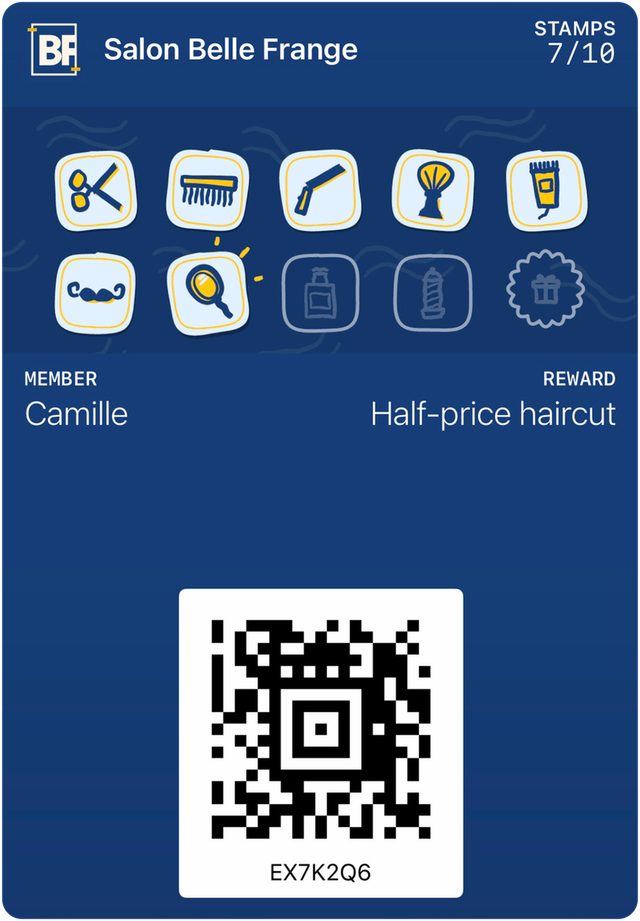
| Salon, barber | every 3 to 6 weeks | medium and regular | Short stamp card, or prepaid pack | Few visits: a 3 to 5 stamp card and a well-timed reminder |
| Restaurant | variable | highly variable | Points or credit | A $20 bill and a $150 bill don’t deserve the same reward |
| Pet store | every 2 to 6 weeks | highly variable | Points | A bag of food and a toy are nothing alike; points follow spending |
Stamps: simple, visible, to be calibrated
Their strength is clarity. Customers see where they stand at a glance, and the reward fits in one sentence.
Their limit is length. In Antavo’s 2026 report, 49.1% of program members find that rewards take too long to earn. A card needs to fill up quickly. As a benchmark, FaveCard, a loyalty card vendor, recommends 8 to 10 stamps for a café or a fast-food counter, 5 to 6 for fast-casual restaurants, 3 to 5 for hair salons and 5 to 6 for nails.
The 8-week rule and the formula to set up your card are in our article on the number of stamps. Read the article on the number of stamps
Points: fair, but make them concrete
Points follow spending, which is fairer when baskets vary. Their flaw is well known: people forget them. According to Antavo, 27% of points earned in 2025 were never spent. Points that sit idle bring no one back.
Two settings help a lot:
- Show the value in money. “$4.20 in rewards” says more than “420 points”.
- Set a low first threshold. A first reward within reach shows customers the program really works.
Credit: clear, but it costs margin
Credit is the easiest mechanic to understand: it’s money. In casual restaurants, like pizzerias and cafés, Toast’s data for the first quarter of 2026 shows that cash back gives the best 90-day retention, 24 to 26%.
Mind the cost: 1 dollar or 1 euro of credit can be spent on any product, often at its selling price. A free product only costs you its cost of goods. In fine dining, the same data shows a free appetizer or dessert does better than cash back: 20% retention versus 13%.
To compare the cost of a discount with that of a free product, see how to work out the cost per visit. Read the article on choosing a reward
Prepaid packs
In a salon, a car wash or a spa, a fourth formula often works better than a card: the prepaid pack. The customer pays upfront, for example five washes or ten sessions, and the card counts down what’s left.
It isn’t quite a loyalty program anymore: it’s a sale. The customer commits, and you get paid right away. In return, they expect a clear benefit, like one free session in the pack, and simple rules. By default, a prepaid pack doesn’t expire, as several consumer protection laws require.
The most common rules on gift cards and prepaid packs are summed up in our guide.
What if I want two?
That’s possible, and sometimes useful: a stamp card for the morning coffee, points for the shop or catering. Keep one rule: customers must understand each program in one sentence. Beyond two, customers get lost, and so does your team.
And for your best customers, a “Regular” status shown on the card can be added to any mechanic. It costs nothing and recognizes those who have been coming for a long time.
What HoorayPass does
Stamps, points, credit, tiers: every program is included, at the same price. During setup, we suggest the one that fits your rhythm, and you can run several at once. You can switch later without changing your price.